Campaign Framework for Creative Studios
A three-tier system for planning and executing marketing campaigns. Maintains narrative coherence across platforms while enabling parallel production and resource visibility. Developed internally, tested over two months.

Marketing for creative studios fails in two predictable ways. The first is chaos: posts happen when inspiration strikes, each platform treated as its own universe, no connection between what you published Tuesday and what you’re trying to achieve this quarter. The second is rigidity: elaborate content calendars that look impressive but shatter on first contact with reality, because they plan outputs without understanding how content actually gets made.
We lived both failure modes before building this.
The framework emerged from a specific question: How do individual social posts build toward Initiative milestones? We had Multi-Clock Work for task governance and Initiatives for strategic alignment. What we didn’t have was any layer showing how a week of LinkedIn posts, Instagram stories, and Substack essays connected to a quarterly outcome.
The solution borrows from agency patterns—adapted for a lean studio without agency resources or, frankly, agency experience. We read the blogs, inferred the principles, and built what seemed to work.
The Gap We Were Staring At
By Week 5 of our Multi-Clock pilot, the governance infrastructure was solid. MIR managed HF/LF/Dormant work across value streams. The Initiatives Register connected Strategic Outcomes to Delivery Channels. Dashboards showed work distribution at a glance.
But when someone asked “Are we executing the campaigns that support our Initiatives?”—I couldn’t answer. Individual tasks completed. Posts went out. The relationship between daily content and quarterly goals remained a black box.
The symptoms were obvious once we named them. Hard to see narrative coherence across LinkedIn, Instagram, Bluesky, and Substack. Our previous solution—a Word document plus Google Calendar—worked locally but had no systemic visibility. No clear view of resource allocation across campaign weeks. Content felt ad-hoc because it was ad-hoc.
The root cause: MIR tracks what gets done. Initiatives track why. Nothing tracked how campaigns unfold week-by-week across platforms.
Design Principles (Inferred, Not Inherited)
Full disclosure: we don’t have agency experience. What we have is industry reading, common-sense inference, and a problem that needed solving. From marketing blogs, agency case studies, and workflow documentation, we noticed patterns that seemed worth adapting.
This section describes what we inferred and chose to implement—not a definitive account of how agencies operate.
The Three-Tier Hierarchy
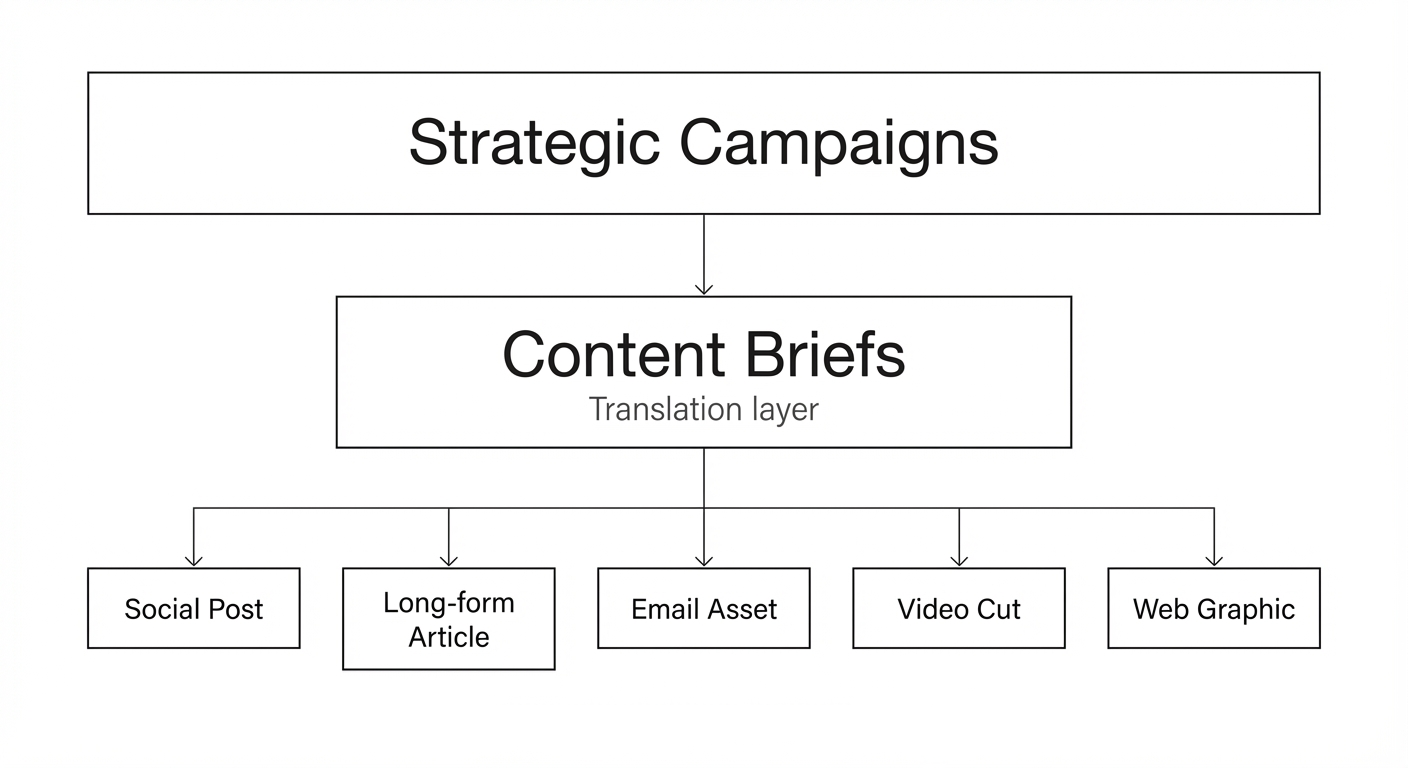
Marketing literature describes layered planning structures. We adopted a three-tier version:
Tier 1: Campaign (Strategic Layer). A 4-12 week container defining objectives, timeline, success metrics, and target audience. Everything else cascades from here. Think of it as the “season” of a TV show.
Tier 2: Content Brief (Tactical Layer). The weekly or biweekly level—a single message expressed across multiple platforms. One Content Brief typically generates 3-6 platform outputs. Think of it as an “episode.”
Tier 3: Production Outputs (Execution Layer). One row per platform output: the specific post, story, essay, or video that gets published. These are the “scenes.”
The metaphor isn’t perfect, but it helped us think about narrative progression. Week 1 shouldn’t repeat Week 4’s message. Each brief advances the arc.
Patterns We Chose to Implement
Batch production. Define the weekly content moment with all platforms identified upfront. Create anchor content first—usually the long-form essay or video. Platform adaptations reference and reuse the primary content. Batch review before publishing: do outputs work together as a set?
Resource visibility. We estimate production time at the content-moment level. “This week requires 5.3 hours across three people.” This surfaces overload before commitment, not after the Thursday panic.
Publishing cadence. Anchor content publishes first (Monday morning). Adaptations follow over three to four days. Staggered timing improves audience experience and reduces cross-platform fatigue. Nobody wants to see the same message on LinkedIn and Instagram within an hour.
Reuse multiplier. One anchor piece generates multiple adaptations. The essay becomes the LinkedIn post, the Bluesky thread, the Instagram carousel caption. This isn’t laziness—it’s message discipline. Each platform gets tailored format while the core message stays stable.
Adapting for Lean Studios
The patterns above assume larger teams with specialized roles. A creative studio with one to two people and AI augmentation needs simplification.
What we kept: Three-tier hierarchy. Anchor-and-adapt pattern. Resource visibility. Batch review.
What we dropped: Client approval layer (we publish direct-to-audience). Multiple specialized tools (everything lives in Notion). Paid distribution tracking (organic-only, at least initially).
What we added: AI agent as first-class production resource. Not a helper—a legitimate Owner with estimated production time.
Our design principle: keep the structure, lose the overhead.
The Anchor-and-Adapt Pattern
This is the operational core. Most multi-platform publishing involves transformation, not independent creation. One piece of anchor content generates multiple platform adaptations.
How It Works
Step 1: Create anchor content. The anchor is typically long-form—a Substack essay (1,500-2,000 words), a YouTube video, a detailed case study. This content gets the most production investment: research, drafting, revision, polish.
Step 2: Extract adaptations. From the anchor, generate platform-specific versions. LinkedIn gets the key insight with professional framing (300-400 words). Bluesky gets a conversational thread (7-8 connected posts). Instagram gets visual slides with minimal text. Each tailored to platform conventions, all drawing from the same source.
Step 3: Mark reuse relationships. Every adaptation’s “Reuses Assets From” field points to the anchor. This creates an explicit dependency chain. If the anchor changes, downstream adaptations may need updates.
Why This Matters
Efficiency. A solo founder leveraging AI this way can materially reduce the time it takes to get from “idea” to “publishable draft,” particularly when campaigns, outcomes, and tasks are linked and reviewed consistently. In our experience, the biggest gains come from faster iteration and clearer decision-making—not from trying to automate judgment.
Quality. But the efficiency argument isn’t the strongest one. When each platform is created independently, message drift happens. LinkedIn emphasizes one angle. Instagram emphasizes another. By week 4, the campaign narrative has fragmented without anyone noticing.
Anchor-and-adapt prevents drift. The anchor is the verified source of truth. Adaptations adjust tone and format, but the core message stays stable because it’s explicitly derived from a single source.
Weekly Workflow
The framework operates on a weekly rhythm. Monday planning sets the week. Production happens in parallel. Batch review ensures coherence. Publishing follows a staggered schedule.
Monday Morning: Planning (45 minutes total)
Content Brief planning (30 min). Review the campaign narrative arc—where are we in the story? Define this week’s Core Message in one sentence. Select target platforms (which 3-4 make sense this week?). Identify the primary format. Create the Content Brief record. Estimate total production time across all outputs.
Production breakdown (15 min). Create one Production Output row per platform. Assign owners. Mark one output as Primary/Anchor, others as Platform Adaptation. Set “Reuses Assets From” for adaptations. Estimate production time per output. Set publish dates (staggered Monday through Wednesday).
Monday to Friday: Production
Parallel production. This is where lean studios gain ground. Andy drafts anchor content (Substack essay). AI agents draft text adaptations in parallel (LinkedIn + Bluesky). George—our AI agent for visual production—creates Instagram content. All work simultaneously; agents can pull from the draft anchor without waiting for final approval.
Review cycle. Draft → In Review → Approved for each output. Review individually (as completed) or batch review (all outputs together for coherence check).
Publishing: Staggered Schedule
Monday 9:00 AM: Anchor (Substack). Monday 11:00 AM: Professional amplification (LinkedIn). Tuesday 2:00 PM: Extended conversation (Bluesky). Wednesday 10:00 AM: Visual culmination (Instagram).
Staggering serves multiple purposes. Each platform gets optimal posting time for its audience. Audiences on multiple platforms don’t see identical content within hours. The anchor establishes the reference; adaptations build on it.
Resource Allocation
One of the framework’s most valuable features is resource visibility. Before committing to a campaign, you can answer: “Do we have capacity for this?”
The principle is simple: estimate production time at the content-moment level, roll up to campaign level, and compare against available capacity. If a second campaign would overwhelm your week, the system surfaces the conflict before you say yes to something you can’t deliver.
Group outputs by owner to see distribution. This prevents the common failure mode where one person drowns while others have slack.
Integration with Multi-Clock Work
The Campaign Framework extends Multi-Clock Work without replacing core principles.
Temporal Governance Applied
HF (High-Frequency): Active campaign content production. The essay being written this week, the carousel being designed today.
LF (Low-Frequency): Campaign planning and performance reviews. Designing next month’s campaign arc, analyzing last campaign’s metrics.
Dormant: Future campaign concepts. The product launch campaign for Q2, the thought leadership series for next year. Parked but not forgotten.
Clock Bands at All Levels
Campaigns carry a Clock property—typically HF when Active, LF when Planning. Content Briefs inherit or override Clock from their parent Campaign. Production Outputs execute within HF bursts (60-90 minute deep work blocks).
WIP Limits Elevated
Task-level WIP: 3-5 per person (unchanged from base MIR). Brief-level WIP: 1-2 Briefs “In Production” simultaneously. Campaign-level WIP: 2-3 Active campaigns maximum.
These limits prevent the common failure of starting many campaigns and finishing none. We learned this the hard way in October—three campaigns active, zero completing on schedule.
The Full Hierarchy
The complete chain from strategy to execution:
Strategic Outcomes (why we exist) → Initiatives (how we achieve outcomes) → Campaigns (6-8 week programs) → Content Briefs (weekly content moments) → Production Outputs (platform deliverables) → MIR Tasks (execution work with Clock governance).
Each level has appropriate temporal governance. Discipline flows from strategy to tactics.
Pilot Results: Two Weeks of Data
We tested the framework through a 2-week internal pilot executing the “Multi-Clock Framework Authority” campaign. These are our numbers, our context, our experience.
What We Produced
8 platform outputs across 2 weeks: 2 anchor essays (Substack), 2 professional posts (LinkedIn), 2 threaded conversations (Bluesky), 2 visual carousels (Instagram).
What Changed
Strategic clarity. Before the framework, most of our outputs had no traceable link to Strategic Outcomes. During the pilot, every piece connected to an explicit campaign objective. The question “Why did we publish this?” always had an answer.
Decision speed. Capacity questions that used to require digging through calendars and spreadsheets became answerable in minutes. The structure made “Can we add this?” a quick lookup rather than a research project.
Publishing consistency. Before: irregular cadence, posts happened “when ready.” During pilot: 8 outputs, 8 on-time. Predictable 3-day rollout for each content moment.
Narrative coherence. Before: individual posts existed in isolation. After: explicit Core Message per week, narrative arc across the campaign. Week 2 engagement built on Week 1 foundation.
Common Pitfalls
Skipping the Middle Tier
The mistake: Go directly from Campaign to Production Outputs, skipping Content Briefs.
What happens: Lost weekly narrative coherence. No clear “content moment” concept. Can’t batch-review related outputs because nothing groups them.
The fix: The middle layer is essential. It’s where message discipline lives. Don’t skip it.
Over-Detailed Production Notes
The mistake: Writing 500-word production notes per output.
What happens: Notes too long; nobody reads them during production. Cognitive overhead without proportional value.
The fix: Compress to 100-150 words. Key attributes, not comprehensive instructions.
Rigid Publishing Schedule
The mistake: All outputs publish the same day (Monday).
What happens: Overwhelms your audience. Loses platform-specific optimization. People notice when they see the same content twice in an hour.
The fix: Stagger across 3 days. Anchor Monday AM; adaptations follow.
Underspecified Briefs
The mistake: Vague Content Briefs that assume AI agents will “figure it out.”
What happens: Revision loops that eat the time savings. Three rounds of “not quite right” when one clear spec would have landed it.
The fix: Invest in specification quality. Clear success criteria, explicit constraints, concrete examples. The bottleneck with AI production isn’t capacity—it’s brief quality.
Campaign Immortality
The mistake: No kill criteria. Campaigns run indefinitely without evaluation.
What happens: Resources locked in underperforming work. No mechanism for stopping. Zombie campaigns consuming attention in the background.
The fix: Explicit kill criteria upfront. “If no qualified inquiries by Week 6, reassess.” Then actually reassess.
Getting Started
Setup took us a day. Three connected databases, one campaign defined, first week’s outputs assigned. The structure is simple enough to build in an afternoon.
What takes longer is calibration—learning your actual rhythms, refining brief templates, developing the muscle memory of batch review. That’s continuous. We’re still adjusting.
The weekly rhythm that emerged: Monday planning, Tuesday-Thursday production, Friday review and scheduling, following week publishing. Monthly: review performance, plan the next campaign, archive what’s done.
Future Extensions
Performance analytics. Add metrics fields to Production Outputs: Impressions, Engagements, Clicks, Conversions. Roll up to Content Brief and Campaign levels. After 4-6 weeks of data, answer: “Which platform actually drives results?”
Asset library. Central repository for reusable assets—photos, graphics, quotes, stats. Source Campaign relation. “Used In” relation to Production Outputs. Prevents the lost-asset scramble.
Automated publishing. Zapier or Make.com integration. Notion trigger when Status changes to “Scheduled.” Action: Post to platform via API. Update Status to “Published.” Trade-off: reduces manual overhead but loses platform-specific formatting nuance. Defer until volume exceeds 12 outputs per week.
Conclusion
The Campaign Framework solves a specific problem: bridging strategic intent to tactical execution in content marketing. We adapted patterns from marketing literature for our lean studio context—maintaining structure without requiring large-team resources.
The core moves: three-tier hierarchy that creates traceable lineage from every post to a strategic outcome. Anchor-and-adapt pattern for message discipline and efficiency. Resource visibility before commitment, not after overload. AI as first-class production resource.
The integration with Multi-Clock Work: clock bands apply at all hierarchy levels. WIP limits elevated to Brief and Campaign tiers. Temporal governance from strategy to execution.
What we observed in our pilot: every output traced to campaign objectives. Faster capacity decisions. On-schedule publishing throughout. And perhaps most importantly, narrative coherence that emerged from structure rather than heroic effort.
The framework isn’t about producing more content. It’s about producing content that compounds—where each week’s work builds on the previous, narrative coherence emerges from structure rather than heroic effort, and resource allocation happens before overcommitment rather than after.
For creative studios balancing multiple initiatives with limited capacity, this is the execution layer that governance systems often lack.